
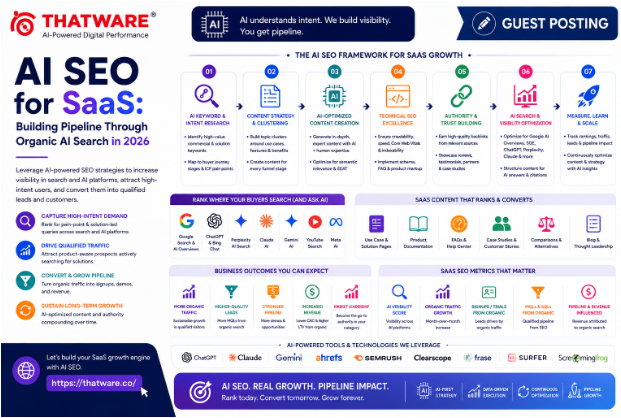
SaaS companies have a complicated relationship with SEO. On one hand, the economics are compelling — a well-ranking article that drives consistent organic signups has a customer acquisition cost that drops toward zero over time, which looks extraordinary next to paid acquisition costs that typically range from hundreds to thousands of dollars per trial. On the other hand, SaaS SEO is genuinely hard. The buying journey is long and complex. The content needed to rank spans everything from early-awareness educational content to bottom-of-funnel competitive comparisons. And the technical complexity of SaaS products means your SEO team and your subject matter experts need to collaborate on content that most writers aren’t equipped to produce without significant guidance.
AI changes the calculus on all of this.
The SaaS Search Intent Landscape
SaaS buyers search differently than consumers do. The journey from awareness to purchase involves months of research, involves multiple stakeholders with different technical and business concerns, and produces a search pattern that spans a huge range of query types.
At the top of the funnel: educational queries about problems and concepts (“what is workflow automation,” “how to reduce churn”). In the middle: comparative and evaluative queries (“best project management software for remote teams,” “Asana vs Monday”). At the bottom: product-specific and vendor queries (“ThatWare AI SEO pricing,” “[competitor] alternatives”).
A SaaS company that only creates content for one segment of this journey is leaving pipeline on the table. The buyer who encountered your educational content six months before they were ready to purchase — and found you helpful, authoritative, and trustworthy — is dramatically easier to convert than the buyer who encounters you for the first time on a demo landing page.
AI SEO services for SaaS help map this entire intent landscape systematically, identifying which stages of the funnel have the most coverage, which have gaps, and where competitors are winning attention at specific stages of the buyer journey.
Technical SEO Challenges in SaaS Products
SaaS applications often create genuine technical SEO complexity. JavaScript-heavy applications can produce crawlability issues. User-generated content in public-facing app areas can create thin content or duplication problems. Frequent product releases can create URL structure instability. And the marketing site often coexists uneasily with the application itself, creating architectural challenges around crawl prioritization.
AI SEO framework for SaaS handles this complexity by treating the technical architecture as a system to be continuously monitored rather than a one-time audit to be completed. Application-generated content gets evaluated for indexation value. URL structure changes get assessed for redirect handling and link equity implications. JavaScript rendering gets tested continuously as the product evolves.
Content That Drives Product-Led Growth
The most effective SaaS SEO content isn’t just informational — it creates what some call “product-led content,” where the content itself delivers value through interaction with the product. A SEO tool that lets you analyze a page inline within a blog post, a writing assistant that demonstrates its capabilities within a tutorial, or a project management app that offers a template download alongside an article about project management frameworks — these convert at dramatically higher rates than content that just explains concepts and ends with a CTA.
AI-informed content strategy can identify which informational topics have strong product-led content potential for your specific product, prioritizing content that serves both the SEO goal and the conversion goal simultaneously.
Building Topical Authority in a Competitive Space
SaaS categories are often extraordinarily competitive from an SEO perspective. Martech, project management, HR software, CRM — these are niches where domain authority leaders have been publishing content for fifteen years. Competing for head terms requires either exceptional domain authority or a very patient strategy.
The AI-first approach focuses on building authority at the entity and topic level rather than trying to outrank authority leaders on individual keywords. By systematically covering the full semantic territory of your product category — with genuine depth, expert perspective, and semantic completeness — SaaS companies can build topical authority that transfers to competitive ranking positions more quickly than link-building-focused approaches alone.
The organic pipeline that results from this kind of authority isn’t built overnight. But once it’s established, it compounds. High-authority pages attract links naturally. Topical authority on secondary topics transfers to competitive head terms over time. The economics of this compounding effect are what make SaaS SEO — done well, at the AI level of sophistication — one of the most attractive growth channels available.
